
When shopping for an affordable gaming laptop or budget workstation, choosing the right entry-level GPU is one of the most critical decisions you will make. The comparison between the Intel Arc A530M vs RTX 3050 represents an exciting showdown between a newcomer pushing modern architecture and a proven market favorite. Intel entered the dedicated laptop graphics scene with its Xe HPG Alchemist architecture, offering modern hardware features like AV1 hardware encoding and XeSS upscaling. Meanwhile, NVIDIA’s GeForce RTX 3050, built on the Ampere architecture, has long served as the benchmark for entry-level 1080p gaming with established driver stability and DLSS support. While the Intel Arc A530M aims to disrupt the budget segment with competitive pricing and advanced media acceleration, NVIDIA’s RTX 3050 counters with reliable performance in older DirectX 11 games and broad software compatibility. This detailed guide breaks down their specs, benchmarks, and real-world performance to help you make an informed purchase.
Feature-by-Feature Comparison Table
Below is a comprehensive technical breakdown comparing the hardware specifications, core configurations, memory bandwidth, and media encoding features of the Intel Arc A530M and the NVIDIA GeForce RTX 3050 (4GB / 6GB Laptop variants).
| Feature / Spec | Intel Arc A530M | NVIDIA GeForce RTX 3050 (4GB / 6GB) |
| Architecture | Xe HPG (Alchemist) | Ampere |
| Process Node | TSMC N6 (6nm) | Samsung 8nm |
| Cores / Execution Units | 12 Xe Cores (1,536 Shading Units) | 2,048 (4GB) / 2,560 (6GB) CUDA Cores |
| Base / Boost Clock | 900 MHz / 1,300 MHz | 1,057 MHz / 1,740 MHz (varies by TGP) |
| VRAM Capacity | 4GB / 8GB GDDR6 | 4GB or 6GB GDDR6 |
| Memory Bus Width | 128-bit | 128-bit (4GB) / 96-bit (6GB) |
| Memory Bandwidth | Up to 224 GB/s | Up to 192 GB/s |
| TGP / Power Range | 65W – 95W | 35W – 80W |
| Upscaling Technology | Intel XeSS | NVIDIA DLSS 2 |
| Ray Tracing Cores | 12 Ray Tracing Units | 16 / 20 RT Cores |
| AI Hardware Acceleration | 192 Intel XMX Engines | 64 / 80 Tensor Cores |
| Video Encoding Support | AV1, HEVC, H.264, VP9 (Dual Media Engine) | NVENC (HEVC, H.264) |
| DirectX Support | DirectX 12 Ultimate (Feature Level 12_2) | DirectX 12 Ultimate |
Quick Highlights Table
If you need a fast overview of how these two mobile graphics chips stack up in practical scenarios, this quick highlights table summarizes key strengths and performance metrics across common use cases.
| Parameter | Intel Arc A530M | NVIDIA GeForce RTX 3050 |
| 1080p Esports Gaming | Excellent (100+ FPS in CS2, Valorant) | Excellent (100+ FPS in CS2, Valorant) |
| 1080p AAA Gaming Performance | Mixed (30–50 FPS in modern DX12 titles) | Solid (45–60 FPS with DLSS) |
| Legacy Game Driver Stability | Fair (Requires ongoing driver optimization) | Excellent (Rock-solid legacy DX9/DX11 support) |
| Video Editing & Encoding | Exceptional (Hardware AV1 + QuickSync) | Good (Reliable NVENC) |
| Power & Efficiency | Moderate (Dynamic Deep Link support) | High (Very efficient low TGP variants) |
| Value for Money | Superior value in ultra-budget laptops | Standard pricing across entry-level gaming laptops |
Key Takeaways
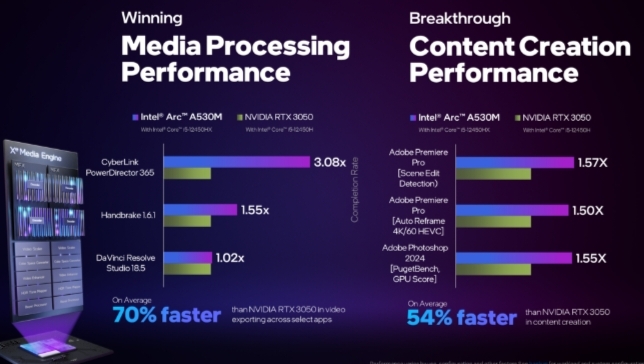
Selecting between these entry-level laptop graphics cards comes down to prioritizing raw gaming consistency versus modern content creation capabilities. Here are the core insights to keep in mind:
- Rasterization Performance is Neck-and-Neck: In modern DirectX 12 and Vulkan titles, the Intel Arc A530M matches or occasionally beats the RTX 3050 4GB when paired with up-to-date drivers.
- NVIDIA Holds the Upscaling Advantage: DLSS 2 remains more widely adopted across games and delivers slightly sharper image reconstruction with better frame rate gains than Intel XeSS.
- AV1 Hardware Encoding Leader: The Arc A530M features full AV1 hardware encoding out of the box, making it a dream card for entry-level streamers and video creators.
- Legacy API Performance: RTX 3050 provides much smoother performance out-of-the-box in older games built on DirectX 9 and DirectX 11 due to decades of driver maturity.
- System Power & Deep Link: Laptops featuring an Intel CPU paired with the Arc A530M benefit from Intel Deep Link technology, dynamic power sharing, and accelerated video rendering.
Pros & Cons
Understanding the strengths and weaknesses of each GPU is crucial when evaluating the intel arc a530m vs rtx 3050 for daily gaming and productivity workloads.
Intel Arc A530M
Pros:
- AV1 Video Encoding: Dual media engine with native AV1 hardware support for modern video editing and streaming.
- High Memory Bandwidth: Offers up to 224 GB/s memory bandwidth, beating the RTX 3050.
- Modern API Optimization: Delivers competitive performance in DirectX 12 Ultimate and Vulkan games.
- Attractive Laptop Pricing: Often found in cheaper budget gaming laptops (such as Lenovo LOQ variants).
Cons:
- Higher power consumption under load compared to lower-wattage RTX 3050 models.
- Performance in older DirectX 9/11 titles requires driver overhead management.
NVIDIA GeForce RTX 3050
Pros:
- Widespread DLSS Adoption: Deep Learning Super Sampling (DLSS) boosts framerates dramatically in hundreds of games.
- Mature Driver Ecosystem: Unmatched reliability and compatibility across older legacy games and creative apps.
- Energy Efficiency: Exceptional performance-per-watt efficiency at low TGP power limits.
- 6GB VRAM Option: Newer RTX 3050 6GB variants offer extra buffer headroom for demanding texture packs.
Cons:
- Lacks hardware AV1 encoding support (restricted to NVENC H.264/HEVC).
- Often carries a higher price tag than equivalent Arc A530M laptop configurations.
Buying Recommendations
Making a final purchase decision depends heavily on your daily workload and primary use case.
Buy the Intel Arc A530M if:
- You focus on content creation and streaming: The hardware AV1 encoder and Intel Deep Link combination provide smoother video export times in Premier Pro and DaVinci Resolve compared to standard budget GPUs.
- You play modern DX12/Vulkan games: If your library consists mostly of newer titles like Cyberpunk 2077, Forza Horizon 5, or Helldivers 2, the Arc A530M holds its ground effectively.
- You want maximum value per dollar: Intel Arc laptops frequently go on sale at lower price points than NVIDIA equivalents without compromising core specs.
Buy the NVIDIA GeForce RTX 3050 if:
- You want “plug and play” gaming stability: The RTX 3050 requires minimal tweaking to run older games, indie titles, or emulation smoothly.
- You rely on DLSS in heavy titles: DLSS 2 gives the RTX 3050 a clear advantage in squeezing extra FPS out of demanding AAA games.
- You get the 6GB VRAM variant: The extra 2GB of VRAM on the refreshed RTX 3050 6GB makes a noticeable difference in modern frame pacing and texture stability.
Final Verdict
When stack up the Intel Arc A530M vs RTX 3050, there is no single universal winner—it entirely comes down to your personal workflow.
NVIDIA’s RTX 3050 remains the safer, highly reliable choice for traditional gamers who prioritize DLSS, low power draw, and consistent driver stability across both brand-new and older games.
On the other hand, the Intel Arc A530M is a formidable challenger that punch above its weight in modern DirectX 12 games, creative workflows, and video processing. With its native AV1 support and high memory bandwidth, the Arc A530M represents an exceptional budget option for content creators, casual gamers, and budget-conscious buyers.
FAQ Section
Q1: Which GPU is better for gaming, Intel Arc A530M or RTX 3050?
Ans: The NVIDIA RTX 3050 generally offers better gaming consistency thanks to DLSS support and mature drivers for older DX11/DX9 titles. However, the Intel Arc A530M performs competitively in modern DirectX 12 games.
Q2: Does the Intel Arc A530M support Ray Tracing?
Ans: Yes, the Intel Arc A530M features 12 dedicated Ray Tracing Units built into its Xe HPG architecture and supports DirectX 12 Ultimate ray tracing features.
Q3: Does Intel Arc A530M have AV1 encoding support?
Ans: Yes, the Intel Arc A530M includes hardware AV1 encoding and decoding via its dual media engine, giving it a key advantage over the RTX 3050 for video editing and live streaming.
Q4: Is XeSS as good as NVIDIA DLSS?
Ans: Intel XeSS delivers impressive AI upscaling performance on Arc GPUs, but NVIDIA DLSS 2 is currently integrated into more games and provides slightly cleaner visual reconstruction.
Q5: How much power (TGP) does the Intel Arc A530M use?
Ans: The Intel Arc A530M operates within a target power range of 65W to 95W TGP, depending on laptop thermal configurations.
Q6: Can the Intel Arc A530M play older DirectX 9 and DirectX 11 games?
Ans: Yes, though older titles originally ran through translation layers, Intel has made massive driver improvements that significantly boost performance in legacy DX9 and DX11 games.
Q7: Which GPU is better value for budget laptop buyers?
Ans: Laptops powered by the Intel Arc A530M are frequently priced lower than RTX 3050 laptops, making the A530M a superior value-for-money option for budget-conscious users seeking solid modern features.
Short Conclusion
In summary, the comparison between the Intel Arc A530M vs RTX 3050 showcases how fast competition is progressing in the budget laptop market. While NVIDIA’s RTX 3050 stays reliable with DLSS and broad game compatibility, Intel’s Arc A530M brings fresh innovation with AV1 encoding, strong DirectX 12 performance, and lower price tags. Pick the RTX 3050 for hassle-free gaming, or choose the Arc A530M for creator tools and great budget performance.
If you have any questions about “Intel Arc A530M vs RTX 3050: Which Budget Laptop GPU Wins”, feel free to let us know through your comments.


