
The PCIe 4.0 SSD market offers impressive speeds, but choosing the right drive isn’t just about peak numbers—it’s about real-world performance, efficiency, and value. Two popular options dominating this space are the Crucial P310 and the Samsung 990 EVO Plus.
Both SSDs promise fast boot times, quick game loads, and smooth multitasking, yet they target different types of users. In this detailed Crucial P310 vs Samsung 990 EVO Plus comparison, we’ll analyze specifications, real-world behavior, thermals, pricing value, and ideal use cases to help you make the right choice in 2026.
Feature-by-Feature Comparison Table
Both drives are high-speed NVMe solutions, but their internal architectures lead to distinct performance profiles.
| Feature | Crucial P310 | Samsung 990 Evo Plus |
| NAND Flash Type | 232-Layer QLC | Samsung V-NAND TLC |
| Interface | PCIe Gen 4 x4 | PCIe Gen 4 x4 / Gen 5 x2 |
| Controller | Phison E27T | Samsung In-house (Nickel-coated) |
| DRAM Cache | No (Uses HMB) | No (Uses HMB) |
| Max Seq. Read | Up to 7,100 MB/s | Up to 7,250 MB/s |
| Max Seq. Write | Up to 6,000 MB/s | Up to 6,300 MB/s |
| Endurance (1TB) | 220 TBW | 600 TBW |
| Form Factors | M.2 2280 & 2230 | M.2 2280 |
On paper, the Samsung 990 EVO Plus holds a small advantage in raw performance, while the Crucial P310 focuses on efficiency and value.
Quick Highlights Table
If you are in a rush, here is the “spark notes” version of how these two SSDs stack up against each other.
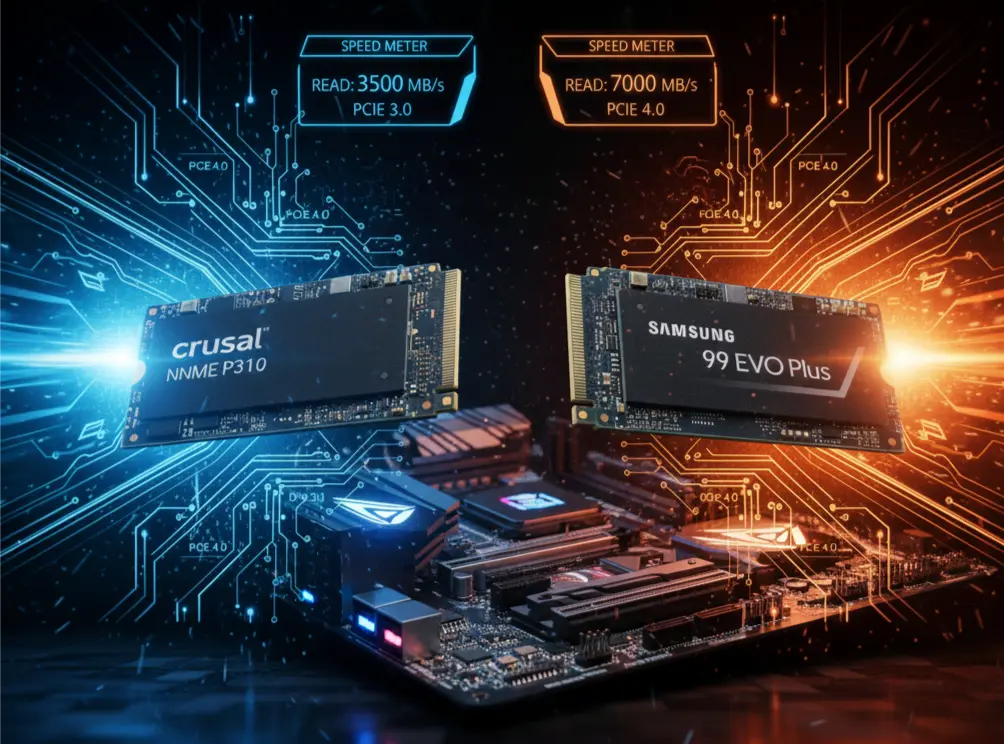
| Highlight | Crucial P310 | Samsung 990 Evo Plus |
| Best For | Budget Builds & Handhelds (Steam Deck) | Heavy Gaming & Creative Work |
| Efficiency | Extremely High (Excellent for Laptops) | High (Optimized Thermal Guard) |
| Longevity | Standard Consumer Use | High-intensity Write Workloads |
| Compatibility | Universal Gen 4 | Future-proofed Hybrid Gen 4/5 |
Real-World Performance: Gaming, Productivity & Daily Use
While benchmarks show measurable differences, real-world usage tells a more practical story.
Gaming:
Both SSDs deliver near-identical game load times. Open-world titles, fast travel, and texture streaming feel equally smooth, with differences often measured in fractions of a second.
Daily Use:
Windows boot times, app launches, and file browsing feel instant on both drives. For general users, responsiveness is effectively the same.
Productivity:
The Samsung 990 EVO Plus pulls ahead in sustained tasks like video editing, large file exports, and heavy multitasking, where its higher random and sustained write performance becomes noticeable.
Thermals & Power Efficiency Comparison
Thermals and efficiency matter—especially for laptops and compact PC builds.
- Crucial P310 runs cooler under light to moderate workloads
- Consumes less power, making it ideal for laptops and SFF systems
- Rarely throttles in everyday scenarios
- Samsung 990 EVO Plus runs warmer during prolonged heavy transfers
- Benefits more from a motherboard or aftermarket heatsink
- Maintains higher sustained speeds under load
For efficiency-focused builds, the Crucial P310 has a clear advantage.
Key Takeaways
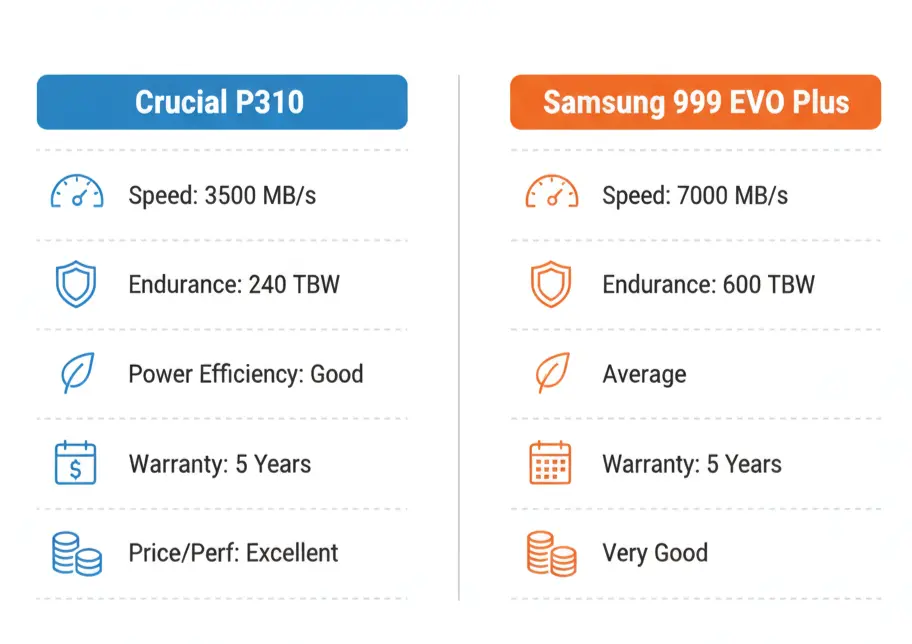
- Performance Parity: In everyday tasks like booting Windows or launching a browser, you won’t feel a difference between the two.
- The TLC Advantage: The Samsung 990 Evo Plus uses TLC (Triple-Level Cell) NAND, which offers significantly higher write endurance than the QLC (Quad-Level Cell) found in the P310.
- Form Factor Flexibility: The Crucial P310 is available in the tiny 2230 size, making it the go-to choice for handheld consoles like the Steam Deck or ROG Ally.
- Hybrid Interface: Samsung’s 990 Evo Plus is unique for supporting PCIe 5.0 x2, allowing it to maintain high speeds even on newer motherboards that split lanes.
Pros & Cons
Choosing between the Crucial P310 vs Samsung 990 Evo Plus depends on whether you value initial savings or long-term durability.
Crucial P310
- Pros:
- Incredible value for a 7,000+ MB/s drive.
- Excellent power efficiency extends laptop battery life.
- Available in 2230 form factor for handhelds.
- Cons:
- Lower endurance (TBW) due to QLC NAND.
- Performance can dip during extremely large file transfers.
Samsung 990 Evo Plus
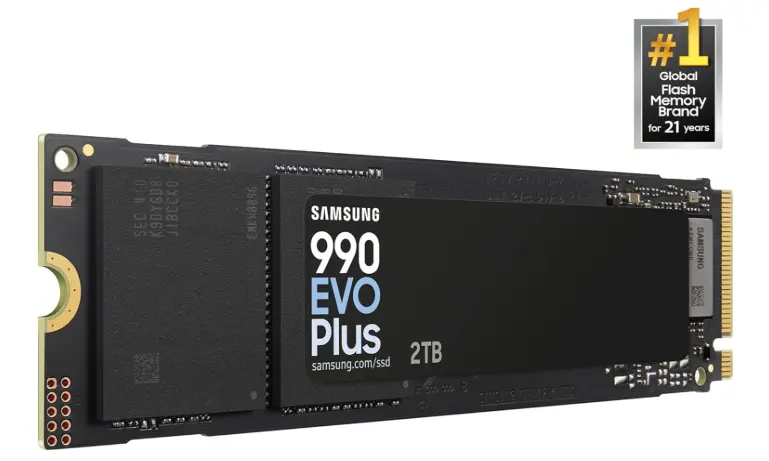
- Pros:
- Superior endurance and reliability for professional use.
- Better thermal management under sustained load.
- Higher random 4K write speeds for snappier multitasking.
- Cons:
- Usually carries a “Samsung Tax” (higher price).
- No 2230 version for ultra-compact devices.
Price-to-Performance Analysis
When value is considered, the difference becomes clearer:
- The Crucial P310 often costs noticeably less while delivering near-flagship performance
- The Samsung 990 EVO Plus justifies its price only if you regularly perform heavy file transfers or professional workloads
For most gamers and everyday users, the Crucial P310 offers better performance per dollar.
Who Should Buy Which SSD?
Choose the Crucial P310 if you are:
- A gamer
- A laptop or mini-PC user
- Building a budget or mid-range PC
- Focused on efficiency and value
Choose the Samsung 990 EVO Plus if you are:
- A content creator or video editor
- A heavy multitasker
- Building a high-end workstation
- Prioritizing sustained performance
Buying Recommendations
- Choose the Crucial P310 if… you are a gamer on a budget, a student, or looking to upgrade the storage in a Steam Deck or ROG Ally. Its performance in gaming is nearly identical to more expensive drives, making the extra cost of TLC hard to justify for casual use.
- Choose the Samsung 990 Evo Plus if… you are a content creator, video editor, or power user who writes hundreds of gigabytes of data weekly. The higher endurance and better thermal stability make it a safer long-term investment for workhorse PCs.
Final Verdict
The Crucial P310 is the efficiency king, proving that QLC NAND can finally compete at the top of the Gen4 charts without breaking the bank. However, the Samsung 990 Evo Plus is the technically superior drive. With its TLC NAND and more robust controller, it offers a “set it and forget it” reliability that Samsung is famous for. If the price gap is less than $20, go with Samsung; if you’re looking for the best deal possible, Crucial wins.
If value matters more than tiny benchmark gains, go Crucial. If performance consistency is your top priority, Samsung still leads.
FAQs
Q1: Does the Samsung 990 Evo Plus have DRAM?
Ans: No, the 990 Evo Plus is a DRAM-less drive. It uses Host Memory Buffer (HMB) technology to use a small portion of your system’s RAM to manage its data map.
Q2: Can I use the Crucial P310 in a PS5?
Ans: Yes, the Crucial P310 meets the sequential read speed requirements for the PS5 (5,500 MB/s or higher), though you should add a third-party heatsink for optimal cooling.
Q3: Is QLC NAND bad for gaming?
Ans: Not at all. For gaming, which mostly involves reading data, QLC is excellent. The endurance concerns mainly apply to users who write massive amounts of data daily.
Q4: What is the difference between the 990 Evo and 990 Evo Plus?
Ans: The “Plus” model offers a significant speed boost (7,250 MB/s vs 5,000 MB/s) and improved power efficiency over the standard 990 Evo.
Q5: Will the Crucial P310 fit in a Steam Deck?
Ans: Yes, but only if you buy the 2230 version. The standard 2280 version is too long for handheld consoles.
Q6: Why does the Samsung 990 Evo Plus support PCIe 5.0?
Ans: It supports a hybrid PCIe 4.0 x4 / 5.0 x2 interface. This doesn’t make it faster than Gen4 speeds, but it ensures compatibility and efficiency on newer Gen5 motherboards.
Q7: Which drive is better for video editing?
Ans: The Samsung 990 Evo Plus is better for video editing because its TLC NAND can handle the constant writing and rewriting of large video files much longer than the P310’s QLC NAND.
Conclusion
Both the Crucial P310 and Samsung 990 Evo Plus represent the pinnacle of modern mainstream storage. Whether you prioritize the high-capacity value of Crucial or the rock-solid endurance of Samsung, you are getting a drive that will make your system feel lightning-fast for years to come.
If you have any questions about this post, “Crucial P310 vs Samsung 990 Evo Plus: Which SSD is Best,” please let us know by your valuable comment.


