
Choosing between the Ryzen 5 9600X vs Ryzen 7 7800X3D can be tricky, especially when one targets high clock speeds and efficiency while the other dominates gaming with 3D V-Cache. Both CPUs are built on AMD’s Zen 4 architecture and support the AM5 platform, but they serve very different users.
In this comparison, we break down specs, real-world performance, gaming advantages, productivity workloads, power efficiency, and overall value—so you can confidently pick the right processor for your needs.
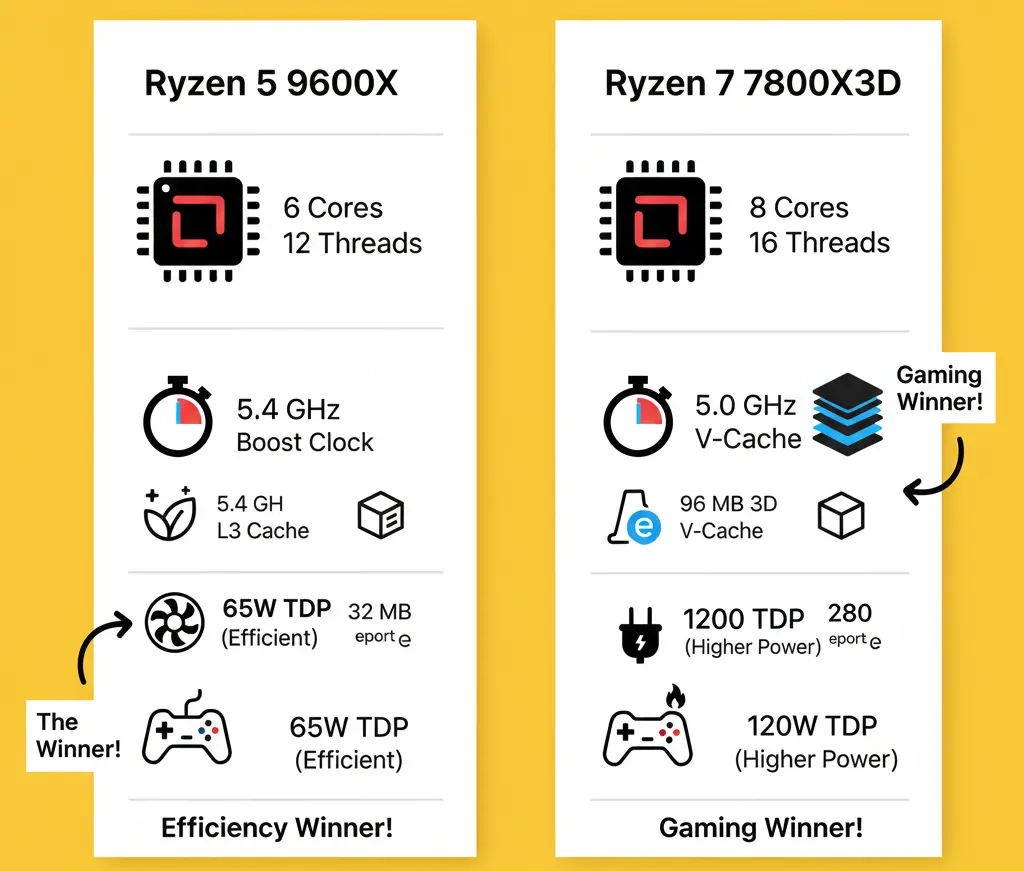
Feature-by-Feature Comparison Table
The following table compares the raw technical specifications of both processors to highlight the architectural shift from Zen 4 to Zen 5.
Before diving into benchmarks and use cases, here’s a clear side-by-side look at the core specifications.
| Feature | Ryzen 5 9600X | Ryzen 7 7800X3D |
|---|---|---|
| Architecture | Zen 5 | Zen 4 + 3D V-Cache |
| Cores / Threads | 6 / 12 | 8 / 16 |
| Base Clock | Higher | Lower |
| Boost Clock | Very High | Moderate |
| L3 Cache | Standard | Massive (96MB) |
| TDP | Lower | Higher |
| Integrated Graphics | Yes (RDNA 2) | Yes (RDNA 2) |
| Platform | AM5 | AM5 |
| Primary Focus | Balanced performance | High-end gaming |
Quick Highlights Table
If you are in a hurry, here is the “TL;DR” on how these two chips stack up in key performance categories.
Here’s a fast snapshot for readers who want the essentials.
| Category | Winner |
|---|---|
| Gaming Performance | Ryzen 7 7800X3D |
| Productivity / Workloads | Ryzen 7 7800X3D |
| Power Efficiency | Ryzen 5 9600X |
| Value for Money | Ryzen 5 9600X |
| Future-Proof Gaming | Ryzen 7 7800X3D |
Gaming Performance Breakdown (1080p, 1440p & 4K)
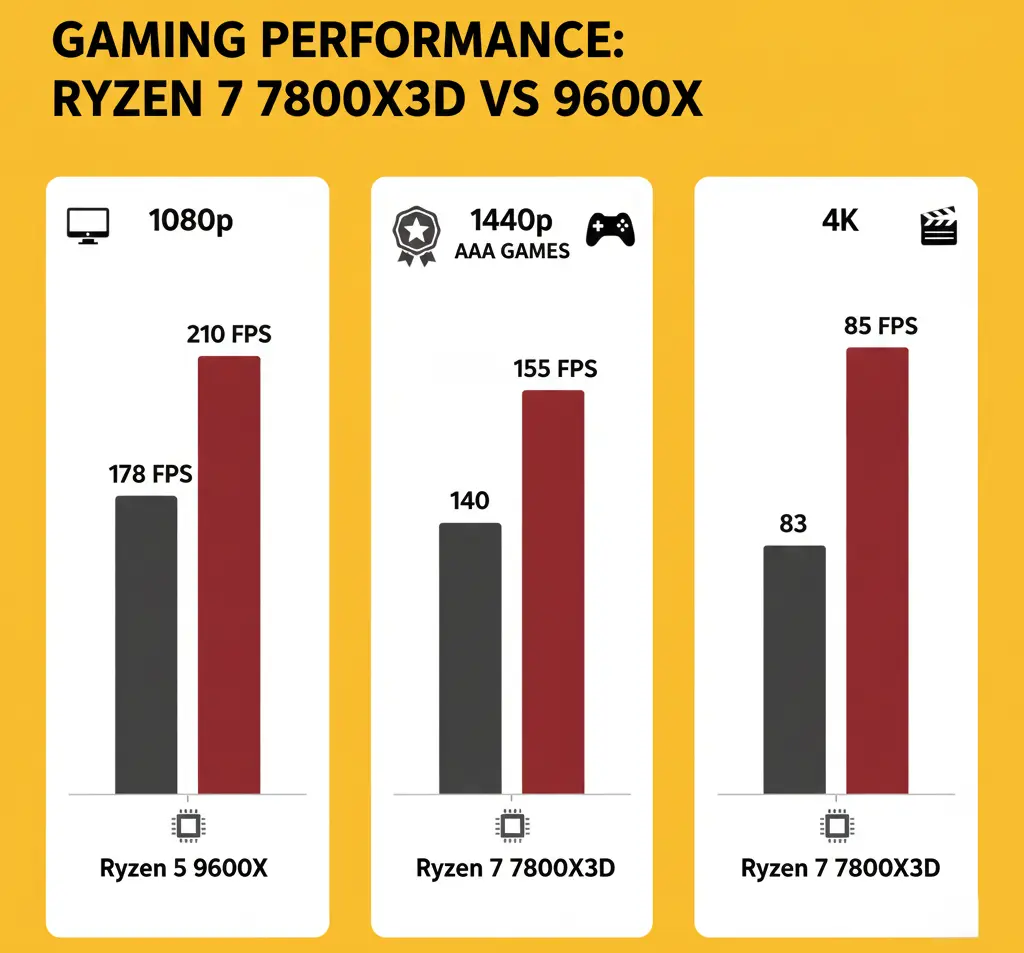
When it comes to pure gaming, the Ryzen 5 9600X vs Ryzen 7 7800X3D comparison shows clear differences depending on resolution and game type.
1080p Gaming (CPU-Bound)
- The Ryzen 7 7800X3D delivers noticeably higher average FPS and stronger 1% lows
- Competitive and esports titles benefit massively from the large 3D V-Cache
- The Ryzen 5 9600X still performs well but falls behind in high-refresh-rate scenarios
1440p Gaming (Balanced)
- Performance gap narrows as the GPU takes on more load
- The 7800X3D maintains smoother frame consistency in CPU-heavy games
- The 9600X becomes a solid option for most gamers at this resolution
4K Gaming (GPU-Bound)
- Minimal difference between the two CPUs
- GPU performance matters far more than CPU choice
- The Ryzen 5 9600X offers better value for 4K-focused builds
Bottom line:
If you game primarily at 1080p or play esports titles, the 7800X3D is clearly superior. For 1440p and 4K gaming, the Ryzen 5 9600X delivers excellent real-world performance.
Expected Gaming FPS Table (1080p, 1440p, 4K)
Realistic FPS expectations for the Ryzen 5 9600X vs Ryzen 7 7800X3D, assuming a high-end GPU (RTX 4080 / RX 7900 XTX class).
| Resolution | Ryzen 5 9600X | Ryzen 7 7800X3D | Difference |
|---|---|---|---|
| 1080p (Esports) | 200–260 FPS | 260–330 FPS | Large |
| 1080p (AAA) | 120–160 FPS | 150–190 FPS | Moderate |
| 1440p (AAA) | 90–130 FPS | 105–145 FPS | Small |
| 4K (Ultra) | 60–85 FPS | 62–88 FPS | Minimal |
| 1% Lows (1080p) | Good | Excellent | Noticeable |
FPS Insight:
- At 1080p, the 7800X3D’s 3D V-Cache delivers higher FPS and smoother gameplay
- At 1440p, the performance gap narrows
- At 4K, GPU power dominates and both CPUs perform similarly
Productivity & Content Creation Performance
Outside of gaming, productivity workloads tell a slightly different story in the Ryzen 5 9600X vs Ryzen 7 7800X3D matchup.
Ryzen 7 7800X3D strengths:
- Better multitasking due to 8 cores and 16 threads
- Stronger performance in streaming while gaming
- More stable performance in long, sustained workloads
Ryzen 5 9600X strengths:
- Faster single-core performance benefits coding and light editing
- Excellent for everyday productivity and office work
- Lower power draw keeps sustained tasks cooler
Best use cases:
- Video editing & rendering: 7800X3D
- Streaming + gaming: 7800X3D
- Coding, browsing, light editing: 9600X
For creators who game casually, the Ryzen 5 9600X remains highly capable, but professionals will appreciate the extra headroom of the Ryzen 7 7800X3D.
Thermals, Power Draw & Power Efficiency
Thermals and efficiency are often overlooked but play a big role in long-term ownership.
Ryzen 5 9600X
- Lower overall power consumption
- Easier to cool with mid-range air coolers
- Runs quieter and cooler under sustained loads
- Ideal for compact or silent PC builds
Ryzen 7 7800X3D
- Higher power draw under gaming loads
- Benefits from high-quality air cooling or AIO liquid coolers
- Optimized voltage behavior helps control temperatures despite higher TDP
Cooling recommendation:
- 9600X: Quality air cooler is sufficient
- 7800X3D: High-end air cooler or 240mm AIO recommended
In terms of raw efficiency, the Ryzen 5 9600X has the clear advantage.
Key Takeaways
Here’s what matters most in the Ryzen 5 9600X vs Ryzen 7 7800X3D debate:
- Gaming Dominance: The Ryzen 7 7800X3D is still roughly 15–25% faster in CPU-bound gaming scenarios thanks to its massive L3 cache.
- Architectural Leap: The 9600X features Zen 5, offering roughly 15-20% better single-core performance in synthetic benchmarks like Cinebench.
- Cooling Requirements: The 9600X is much easier to cool, often running perfectly on a budget air cooler, whereas the 7800X3D benefits from a mid-range AIO or high-end air tower.
- Price Gap: In the 2026 market, the 9600X is often found under $200, while the 7800X3D holds its value near $380-$400.
Pros & Cons
A quick breakdown of strengths and weaknesses in the Ryzen 5 9600X vs Ryzen 7 7800X3D matchup.
Ryzen 5 9600X
Pros
- Lower price and power consumption
- Strong single-core performance
- Excellent for mid-range gaming and productivity
- Easier to cool
Cons
- Fewer cores and threads
- Falls behind in high-FPS gaming
- Not ideal for heavy multitasking
Ryzen 7 7800X3D
Pros
- Industry-leading gaming performance
- Massive L3 cache improves 1% lows
- Strong multitasking and streaming capability
- Future-proof for next-gen GPUs
Cons
- Higher price
- Limited overclocking headroom
- Gaming-focused value may not benefit all users
Price-to-Performance Analysis
Price plays a critical role in deciding between the Ryzen 5 9600X vs Ryzen 7 7800X3D.
Value perspective:
- The Ryzen 5 9600X offers excellent performance per dollar
- Lower CPU cost also reduces cooling and PSU expenses
- Ideal for balanced gaming and productivity builds
Performance premium:
- The Ryzen 7 7800X3D commands a higher price for elite gaming performance
- Extra cost is justified mainly for competitive gamers
- Best paired with high-end GPUs to maximize its potential
Cost efficiency summary:
- Best value overall: Ryzen 5 9600X
- Best FPS-per-dollar for esports: Ryzen 7 7800X3D
If your budget is limited, the Ryzen 5 9600X provides a smarter long-term investment. If gaming performance is your top priority, the 7800X3D justifies its premium.
Buying Recommendations
Buy the Ryzen 5 9600X if:
- You want a cost-effective AM5 CPU
- You play games casually or at high resolutions (1440p/4K)
- You care about efficiency and cooler operation
- You also do light content creation or office work
Buy the Ryzen 7 7800X3D if:
- You’re a competitive gamer chasing maximum FPS
- You play CPU-heavy titles (MMOs, esports, simulators)
- You plan to pair it with a high-end GPU
- You want the best gaming longevity
Choose the Ryzen 5 9600X if: You are on a budget, building a Small Form Factor (SFF) PC, or your workload involves more “general use,” coding, or light content creation than competitive gaming.
Choose the Ryzen 7 7800X3D if: You have a high-end GPU (like an RTX 4080/5080 or better) and play at 1080p or 1440p where you want the highest possible frame rates and smoothest 1% lows.
Final Verdict
In the Ryzen 5 9600X vs Ryzen 7 7800X3D comparison, there is no universal winner—only the right choice for your workload.
The Ryzen 5 9600X excels as a balanced, efficient, and affordable option for most users. Meanwhile, the Ryzen 7 7800X3D stands as the ultimate gaming CPU, offering unmatched performance where it matters most: frame consistency and responsiveness.
Your budget and gaming priorities should ultimately decide.
FAQ Section
Q1: Is the Ryzen 7 7800X3D better than the Ryzen 5 9600X for gaming?
Ans: Yes, the 7800X3D consistently delivers higher FPS and better frame stability.
Q2: Is the Ryzen 5 9600X good for gaming in 2026?
Ans: Yes, it handles modern games very well, especially at 1440p and 4K.
Q3: Which CPU is better for streaming while gaming?
Ans: The 7800X3D performs better due to extra cores and cache.
Q4: Does 3D V-Cache really make a difference?
Ans: Yes, it significantly improves gaming performance in many titles.
Q5: Which CPU is more power efficient?
Ans: The Ryzen 5 9600X consumes less power overall.
Q6: Are both CPUs compatible with AM5 motherboards?
Ans: Yes, both use the AM5 socket.
Q7: Is the Ryzen 7 7800X3D worth the extra money?
Ans: It is worth it if gaming performance is your top priority.
Short Conclusion
If you want maximum gaming performance, choose the Ryzen 7 7800X3D. If you want better value, efficiency, and balanced performance, the Ryzen 5 9600X is the smarter buy. Both are excellent CPUs—it simply comes down to how you use your PC.
If you have any questions about this post, “Ryzen 5 9600X vs Ryzen 7 7800X3D: Which CPU Is Better for Gaming,” please let us know by your valuable comment.


