
In the ever-evolving world of PC gaming, finding the perfect balance between performance and price is a quest many enthusiasts undertake. For those on a tighter budget, NVIDIA’s GeForce GTX 1050 and its slightly more potent sibling, the GTX 1050 Ti, have long been popular choices. These GPUs carved out a niche as reliable entry-level cards, capable of delivering a solid 1080p gaming experience without breaking the bank. But which one offers the better bang for your buck in today’s landscape?
Let’s dive deep into the NVIDIA GeForce GTX 1050 vs 1050 Ti debate to help you make an informed decision.
Feature-by-Feature Comparison Table
Before diving into performance, let’s compare the core specifications of the NVIDIA GeForce GTX 1050 and NVIDIA GeForce GTX 1050 Ti.
To properly compare these two contenders, let’s look at their core specifications side-by-side.
| Feature | NVIDIA GeForce GTX 1050 | NVIDIA GeForce GTX 1050 Ti |
| GPU Architecture | Pascal (GP107) | Pascal (GP107) |
| CUDA Cores | 640 | 768 |
| Boost Clock | 1455 MHz | 1392 MHz |
| Base Clock | 1354 MHz | 1290 MHz |
| VRAM | 2GB GDDR5 | 4GB GDDR5 |
| Memory Interface | 128-bit | 128-bit |
| Memory Bandwidth | 112 GB/s | 112 GB/s |
| TDP | 75W | 75W |
| Power Connector | PCIe Slot Powered (No extra) | PCIe Slot Powered (No extra) |
| Release Price | $109 | $139 |
Key Spec Differences:
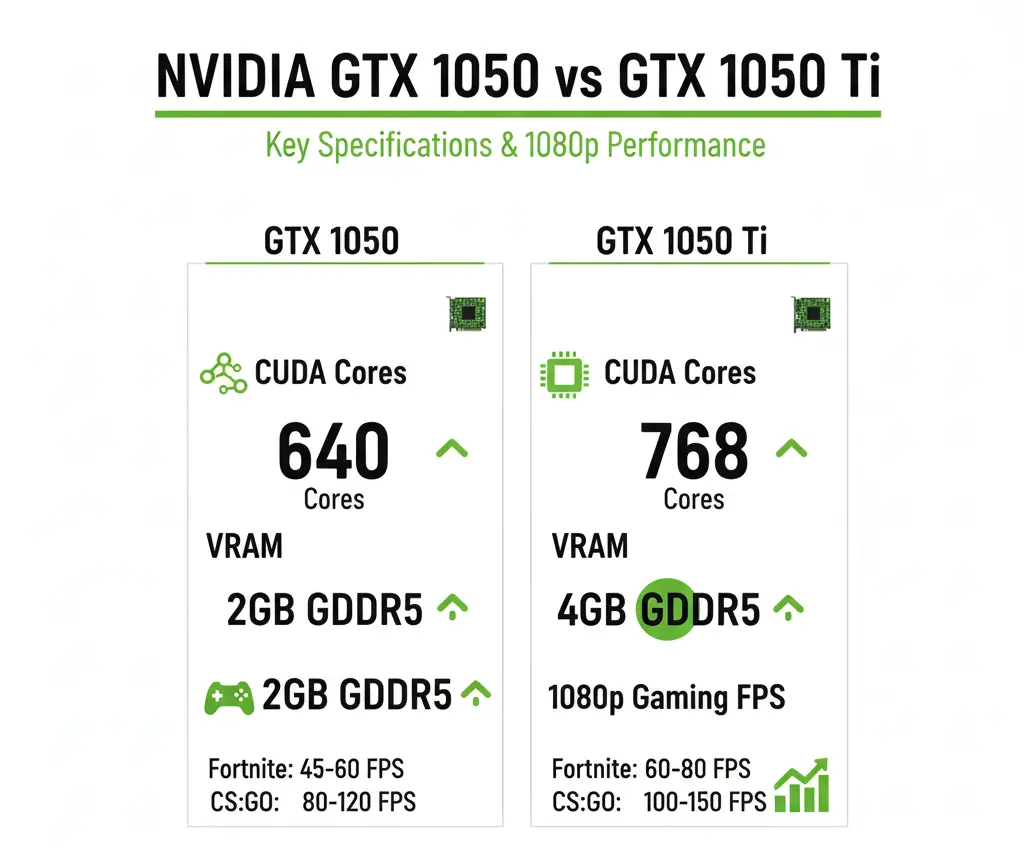
- 20% more CUDA cores on the 1050 Ti
- Double the VRAM (4GB vs 2GB)
- Same power consumption
What These Differences Mean
- The 1050 Ti has 20% more CUDA cores.
- The biggest difference is VRAM (2GB vs 4GB).
- Both are extremely power-efficient.
- The 1050 Ti offers better long-term usability.
Quick Highlights Table
Here’s a simplified breakdown of the GTX 1050 vs 1050 Ti comparison:
Here’s a snapshot of the key differences to consider.
| Highlight | GTX 1050 | GTX 1050 Ti |
| VRAM | 2GB GDDR5 | 4GB GDDR5 |
| CUDA Cores | 640 | 768 |
| Performance Edge | Entry-level | Mid-entry-level |
| Price | Lower | Slightly Higher |
| Future-Proofing | Less | More |
Key Takeaways
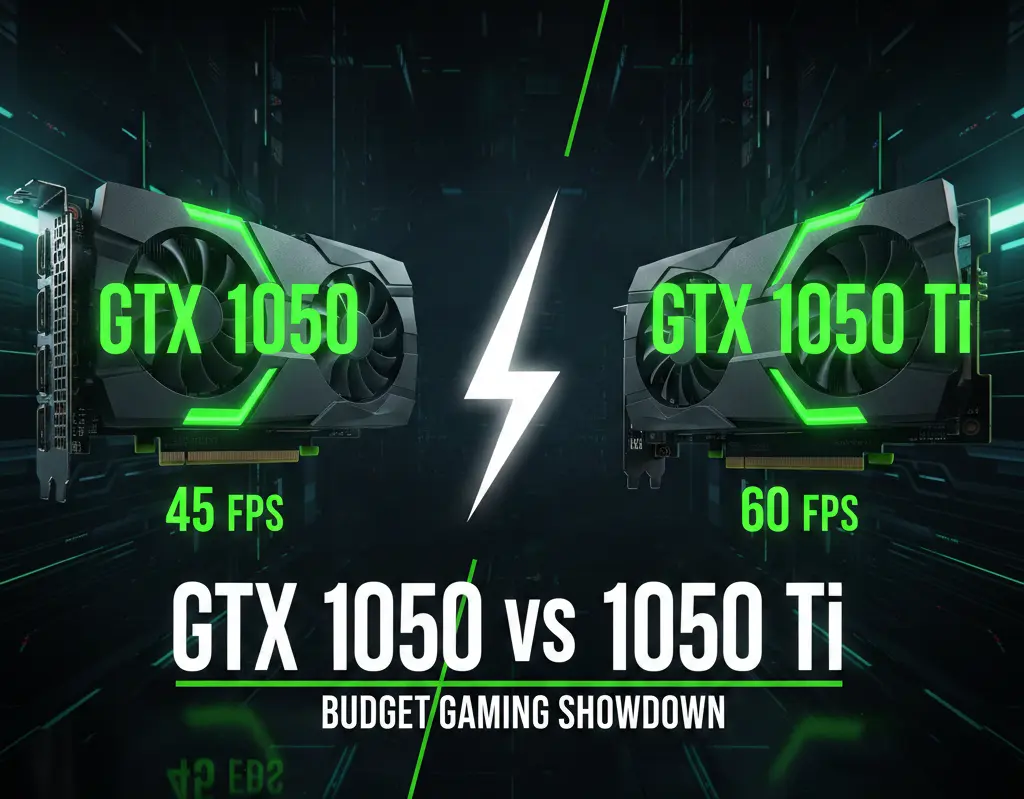
If you don’t want to read everything, here’s what matters most in the NVIDIA GeForce GTX 1050 vs 1050 Ti comparison.
When evaluating the GTX 1050 vs. 1050 Ti, several crucial points emerge:
- VRAM Advantage: The 1050 Ti’s 4GB of VRAM is its most significant advantage, offering better performance in VRAM-intensive games and at higher texture settings compared to the 1050’s 2GB.
- CUDA Core Count: With 768 CUDA cores, the 1050 Ti possesses more processing power than the 1050’s 640 cores, leading to a noticeable performance uplift.
- Power Efficiency: Both cards are remarkably power-efficient, drawing all their power directly from the PCIe slot, meaning no additional power connectors are required. This makes them ideal for systems with weaker power supplies.
- Price Difference: Historically, there was a roughly $30-$40 price difference, which for budget builds, could be a significant factor.
1080p Gaming Performance
Here’s how the GTX 1050 vs 1050 Ti performs in popular games at 1080p Medium settings:
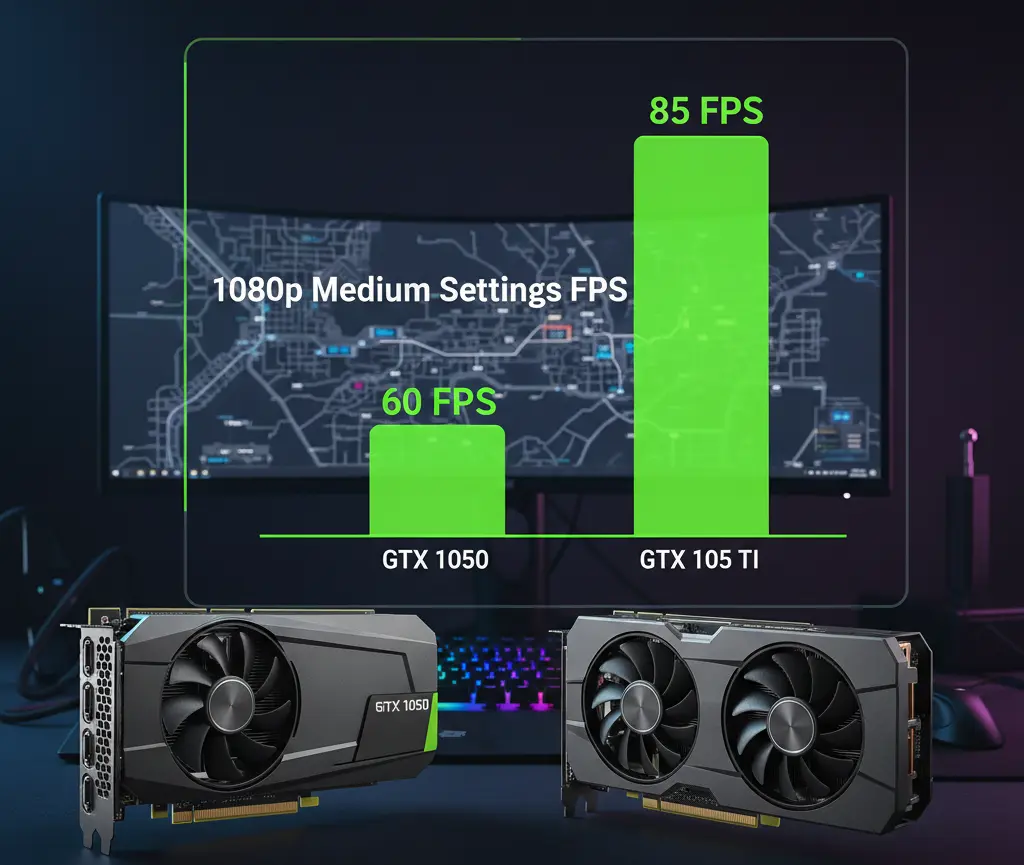
| Game | GTX 1050 | GTX 1050 Ti |
|---|---|---|
| GTA V | ~45 FPS | ~55 FPS |
| Fortnite | ~60 FPS | ~75 FPS |
| Apex Legends | ~40 FPS | ~50 FPS |
| CS2 | ~90 FPS | ~110 FPS |
| PUBG | ~35 FPS | ~45 FPS |
Performance Difference
- The GTX 1050 Ti is generally 10–20% faster.
- 4GB VRAM prevents stuttering in newer games.
- The GTX 1050 struggles in modern AAA titles due to memory limitations.
System Requirements & PSU Compatibility
One reason these GPUs remain popular is their compatibility.
- Minimum 300W PSU recommended
- No 6-pin connector required (most models)
- Ideal for Dell, HP, Lenovo OEM upgrades
- Great for compact or small form factor PCs
Both are excellent for older systems that cannot support high-power GPUs.
Pros & Cons
Let’s break down the advantages and disadvantages of each card in the GTX 1050 vs 1050 Ti comparison.
NVIDIA GeForce GTX 1050
Pros:
- More affordable initial cost.
- Excellent power efficiency (no external power connector needed).
- Capable of 1080p gaming on older or less demanding titles.
- Ideal for ultra-budget builds or upgrading older systems.
Cons:
- Limited 2GB VRAM struggles with newer games at higher settings.
- Lower performance ceiling compared to the 1050 Ti.
- Less future-proof.
NVIDIA GeForce GTX 1050 Ti
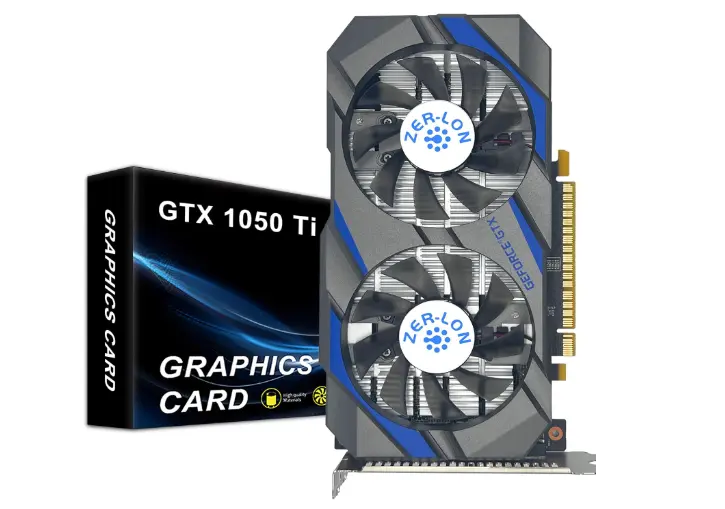
Pros:
- 4GB VRAM significantly improves performance in modern games and allows for higher texture settings.
- Higher CUDA core count provides a noticeable performance boost over the 1050.
- Better long-term value for budget gaming.
- Still very power-efficient (no external power connector needed).
Cons:
- Slightly higher price point.
- While better, still an entry-level card with limitations for very demanding AAA titles.
Buying Recommendations
For anyone building a new system or upgrading an old one, the NVIDIA GeForce GTX 1050 Ti generally offers a better overall experience due to its 4GB of VRAM and higher CUDA core count. This makes it more capable of handling modern games at 1080p with decent settings. If your budget is extremely tight, the GTX 1050 can still serve a purpose for esports titles or older games, but you’ll hit VRAM limitations quickly in newer releases.
If you can find a used GTX 1050 Ti at a good price, it’s often the superior choice. However, with newer budget GPUs now available (like the GTX 1650 or RX 6400), both the 1050 and 1050 Ti are best considered if you’re getting them at a significant discount or already own one.
Final Verdict
In the battle of NVIDIA GeForce GTX 1050 vs 1050 Ti, the GTX 1050 Ti clearly wins overall.
While both cards share the same 75W power efficiency and Pascal architecture, the extra CUDA cores and especially the 4GB VRAM give the 1050 Ti a noticeable advantage in real-world gaming. 2GB VRAM is simply too limiting for many titles.
If you’re buying used, the 1050 Ti is almost always worth the small extra investment.
In the battle of the NVIDIA GeForce GTX 1050 vs 1050 Ti, the GTX 1050 Ti emerges as the stronger option. Its 4GB of VRAM provides crucial breathing room for modern games, and the increased CUDA cores offer a tangible performance boost. While both are older cards, the 1050 Ti’s enhanced capabilities make it a more viable choice for budget-conscious gamers looking for a smoother 1080p experience, assuming the price is right.
Better Alternatives
If you’re open to newer or slightly stronger used GPUs, consider:
- NVIDIA GeForce GTX 1650 – 30–40% faster than 1050 Ti
- AMD Radeon RX 570 – Stronger raw performance but higher power draw
- AMD Radeon RX 6400 – Modern architecture, efficient but PCIe-limited
If priced similarly, these may provide better long-term value.
FAQ Section
Q1: Is GTX 1050 still good in 2026?
Ans: It’s fine for esports and older games at 1080p low settings, but 2GB VRAM limits performance in newer titles.
Q2: Is GTX 1050 Ti much better than GTX 1050?
Ans: Yes, it offers around 10–20% better performance and double the VRAM.
Q3: Does GTX 1050 need external power?
Ans: Most models do not require a 6-pin connector.
Q4: Can GTX 1050 Ti run GTA V?
Ans: Yes, at 1080p medium settings with playable frame rates.
Q5: Which is better for Fortnite?
Ans: GTX 1050 Ti provides smoother performance and better stability.
Q6: Is 4GB VRAM enough for gaming?
Ans: For older and esports titles, yes. For modern AAA games, it’s becoming the minimum requirement.
Q7: Should I upgrade from GTX 1050 to 1050 Ti?
Ans: Only if you’re getting it very cheap. Otherwise, consider a newer GPU for a meaningful upgrade.
Q8: Is the GTX 1050 Ti still good for gaming in 2024?
Ans: It can still handle less demanding games and older titles at 1080p with respectable frame rates, but it will struggle with modern AAA games on medium-high settings.
Q9: Does the GTX 1050 or 1050 Ti require external power?
Ans: No, both the GTX 1050 and 1050 Ti draw all their power directly from the PCIe slot, requiring no additional power connectors from your power supply.
Q10: What’s the main difference between the 1050 and 1050 Ti?
Ans: The main differences are the GTX 1050 Ti having 4GB of VRAM (vs. 2GB for the 1050) and more CUDA cores (768 vs. 640), leading to better performance, especially in newer games.
Q11: Can the GTX 1050 Ti run esports titles like Valorant or CS:GO well?
Ans: Yes, the GTX 1050 Ti is perfectly capable of running popular esports titles like Valorant, CS:GO, League of Legends, and Fortnite at 1080p with high frame rates.
Q12: Is upgrading from a GTX 1050 to a GTX 1050 Ti worth it?
Ans: While it offers a noticeable improvement, the jump from a GTX 1050 to a 1050 Ti might not be significant enough to justify buying a “new” old card. Consider saving up for a more modern budget GPU if you’re looking for a substantial upgrade.
Q13: Are these cards suitable for video editing or content creation?
Ans: For very basic video editing or light content creation, they can suffice. However, for more demanding tasks, you would benefit significantly from a GPU with more VRAM and processing power.
Q14: What modern budget GPUs are alternatives to the 1050/1050 Ti?
Ans: Current alternatives in the budget segment include the NVIDIA GTX 1650 and AMD Radeon RX 6400 or RX 6600, offering better performance and newer features.
Short Conclusion
In the budget gaming arena, both the NVIDIA GeForce GTX 1050 and 1050 Ti offered compelling value in their prime. While newer cards have surpassed them, for those looking at the used market or upgrading a very old system, the GTX 1050 Ti remains the more capable option, thanks to its superior VRAM and CUDA core count. Always weigh the current market prices against newer alternatives to ensure you’re making the smartest choice for your gaming needs.
The NVIDIA GeForce GTX 1050 vs 1050 Ti comparison is simple: both are efficient budget GPUs, but the 1050 Ti offers better gaming performance, more VRAM, and stronger long-term value. If the price gap is small, the GTX 1050 Ti is the clear winner.
If you have any questions about “NVIDIA GeForce GTX 1050 vs 1050 Ti: Which GPU Wins?”, then feel free to let us know through your comments.


