
Samsung has long dominated the NVMe market, but the recent release of the Samsung 990 EVO Plus has blurred the lines between “mainstream” and “flagship” storage. While the Samsung 990 Pro has been the gold standard for PCIe 4.0 performance since its launch, the new EVO Plus offers surprisingly similar speeds at a lower price point.
In this Samsung 990 Evo Plus vs 990 Pro comparison, we break down two of Samsung’s most popular PCIe Gen4 NVMe SSDs to help you decide which one fits your needs best.
Both drives are designed for fast boot times, smooth gaming, and demanding workloads—but they target different types of users. The Samsung 990 Evo Plus focuses on efficiency and value, while the Samsung 990 Pro is built for maximum performance and endurance.
In this guide, we dive deep into the Samsung 990 EVO Plus vs 990 Pro debate to see if the Pro’s dedicated DRAM still justifies its premium, or if the more power-efficient, hybrid-interface EVO Plus is the new king of value.
Feature-by-Feature Comparison Table
While both drives utilize Samsung’s high-end V-NAND technology, their internal architectures differ significantly, particularly regarding how they handle data mapping and PCIe lane configurations.

| Feature | Samsung 990 EVO Plus | Samsung 990 Pro |
| Interface | PCIe 4.0 x4 / 5.0 x2 | PCIe 4.0 x4 |
| Controller | Samsung Piccolo (5nm) | Samsung Pascal (8nm) |
| DRAM Cache | No (Uses HMB) | Yes (LPDDR4) |
| NAND Type | 236-Layer V8 TLC | 176-Layer V7 TLC |
| Max Capacity | 4TB | 4TB |
| NVMe Version | 2.0 | 2.0 |
| Heatsink Option | No (Nickel coating only) | Yes (Optional) |
Quick Highlights Table
If you are looking for a “too long; didn’t read” summary of how these two powerhouse drives stack up in real-world performance metrics, here is the breakdown.
| Metric | Samsung 990 EVO Plus | Samsung 990 Pro |
| Seq. Read Speed | Up to 7,250 MB/s | Up to 7,450 MB/s |
| Seq. Write Speed | Up to 6,300 MB/s | Up to 6,900 MB/s |
| Random Read (IOPS) | 1,050K | 1,400K |
| Random Write (IOPS) | 1,400K | 1,550K |
| Power Efficiency | High (73% better than 990 EVO) | Moderate |
| Endurance (2TB) | 1,200 TBW | 1,200 TBW |
Key Takeaways
Before we look at the specific pros and cons, here are the most important things to know about the Samsung 990 EVO Plus vs 990 Pro:
- The DRAM Gap: The 990 Pro features dedicated DRAM, which helps it maintain higher speeds during massive, sustained file transfers (50GB+). The EVO Plus uses Host Memory Buffer (HMB) technology, leveraging a tiny bit of your system’s RAM instead.
- Thermal Efficiency: The 990 EVO Plus runs cooler and is more power-efficient, making it a superior choice for thin laptops where airflow is limited.
- Gaming Performance: In actual game loading tests, the difference is negligible. Both drives will load modern titles in almost identical timeframes.
- PCIe 5.0 Support: Interestingly, the EVO Plus supports PCIe 5.0 (though only on 2 lanes), providing unique versatility for newer motherboards.
Real-World Performance Breakdown
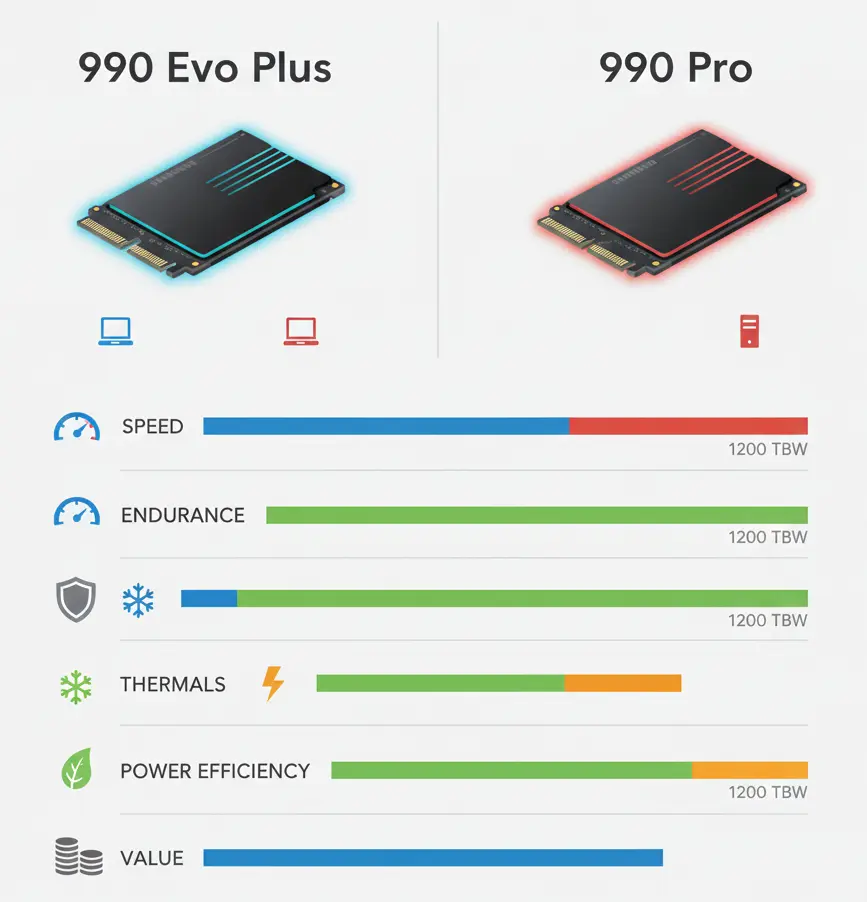
On paper, the Samsung 990 Evo Plus vs 990 Pro specs look very close, but real-world usage tells a clearer story. In everyday tasks like booting Windows, launching apps, or loading games, both SSDs feel equally fast. System startup times are nearly identical, and common applications open instantly on both drives.
The difference appears during sustained workloads. When transferring large files continuously or handling heavy multitasking, the Samsung 990 Pro maintains higher speeds for longer due to its DRAM cache. Meanwhile, the Samsung 990 Evo Plus may dip slightly once its cache is saturated—but this is rarely noticeable for average users.
For most people, real-world responsiveness feels the same. Only power users pushing their storage hard every day will consistently benefit from the Pro’s extra headroom.
Gaming Performance Analysis
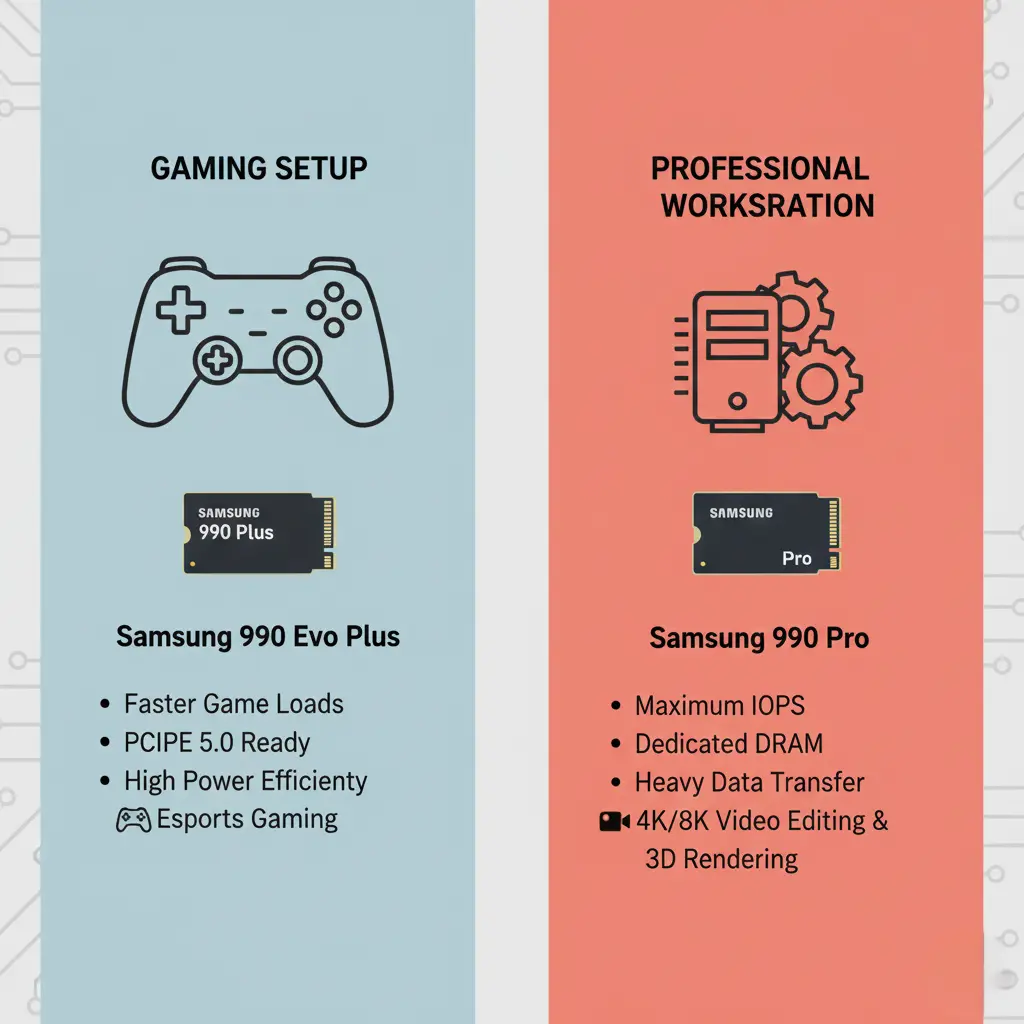
For gaming, the Samsung 990 Evo Plus vs 990 Pro debate is surprisingly simple: there is virtually no difference.
Both SSDs:
- Deliver extremely fast game load times
- Handle texture streaming smoothly
- Prevent stutters in large open-world titles
- Fully support DirectStorage-style workloads
In real gaming scenarios, frame rates are not affected by choosing the Pro over the Evo Plus. Level loading times differ by fractions of a second—often impossible to notice without a stopwatch.
If you’re building a gaming PC or upgrading a PS5-compatible NVMe SSD, the Evo Plus already provides everything modern games require. The Pro does not offer a meaningful gaming advantage unless gaming is combined with heavy background tasks like recording, streaming, or asset creation.
Thermals & Power Efficiency
Thermal behavior is an important but often overlooked factor in the 990 Evo Plus vs 990 Pro comparison.
The 990 Evo Plus is designed with efficiency in mind:
- Runs cooler under sustained loads
- Draws less power
- Better suited for laptops and small-form-factor PCs
The 990 Pro, while faster under heavy workloads, tends to run hotter, especially during long write sessions. For desktops, this is easily managed with motherboard heatsinks or aftermarket cooling, but in compact systems, it can matter.
If you care about battery life, quiet operation, or lower temperatures, the Evo Plus has a clear advantage.
Price-to-Performance Analysis
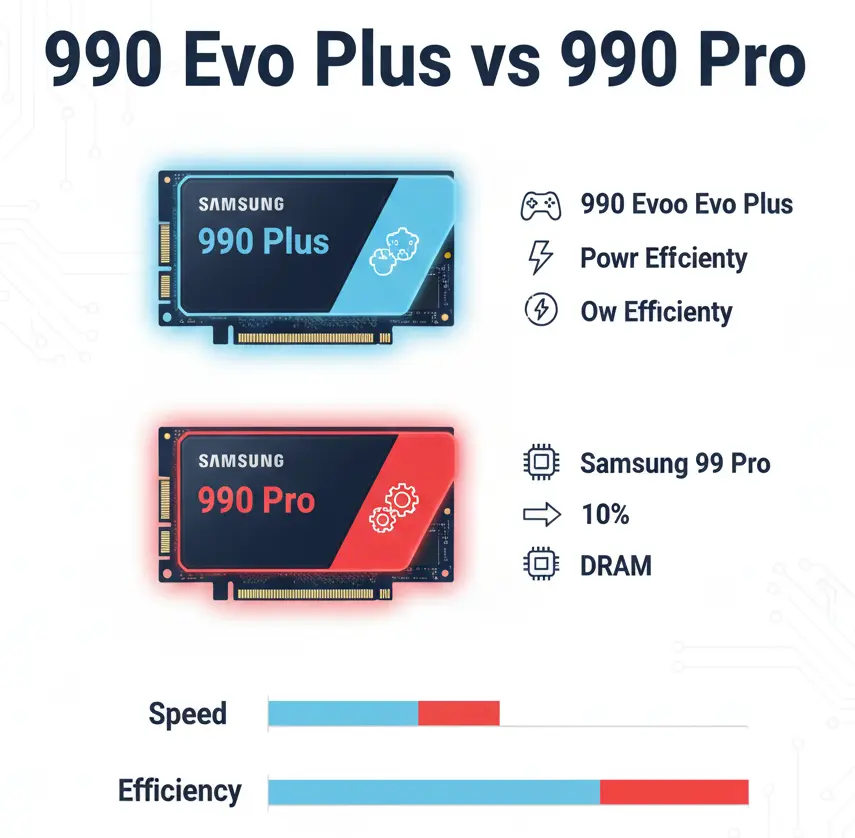
This is where the Samsung 990 Evo Plus vs 990 Pro comparison becomes decisive for most buyers.
While the 990 Pro is technically faster, its real-world advantage is limited to specific professional workloads. The Evo Plus delivers around 90–95% of the experience at a noticeably lower cost per GB.
In short:
- The Evo Plus offers better value for money
- The Pro charges a premium for performance most users won’t fully utilize
Unless your workflow demands constant high-end storage performance, the Evo Plus wins on price-to-performance.
Who Should NOT Buy Each SSD
Who Should NOT Buy the 990 Evo Plus
- Users who perform daily heavy write workloads
- Professionals working with large datasets or databases
- Those who need maximum endurance over many years
Who Should NOT Buy the 990 Pro
- Casual users and gamers
- Laptop users focused on battery life
- Buyers who won’t benefit from DRAM-based sustained performance
Pros & Cons of Samsung 990 Evo Plus and 990 Pro
Every piece of hardware has its trade-offs. Here is a look at the strengths and weaknesses of the Samsung 990 EVO Plus vs 990 Pro.
Samsung 990 EVO Plus
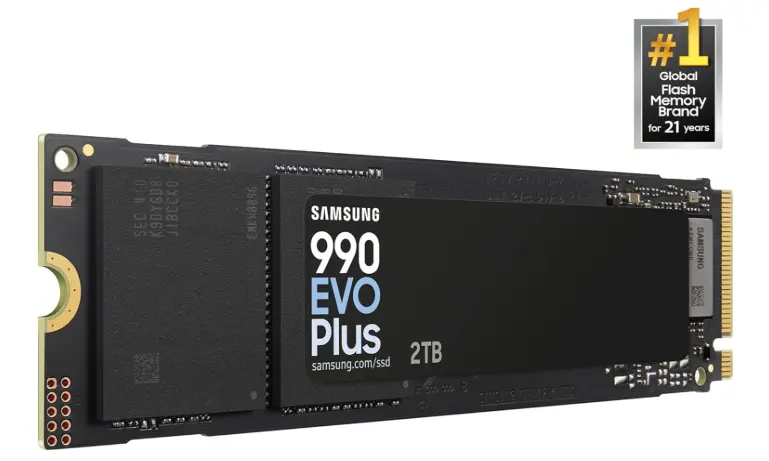
Pros:
- More affordable price-per-GB.
- Incredible power efficiency (longer laptop battery life).
- Newer 236-layer NAND technology.
- PCIe 5.0 x2 compatibility.
Cons:
- DRAM-less design can lead to slower performance during extremely heavy multitasking.
- Slightly lower sequential write speeds than the Pro.
Samsung 990 Pro

Pros:
- Onboard LPDDR4 DRAM for professional-grade stability.
- Highest random IOPS for heavy database or workstation use.
- Available with a factory-installed heatsink for high-heat environments (like the PS5).
Cons:
- Higher price tag.
- Consumes more power and generates more heat.
Buying Recommendations
Choose the 990 Evo Plus if you:
- Want fast boot times and smooth gaming
- Are upgrading a laptop or small-form-factor PC
- Care about efficiency and lower temperatures
- Want the best performance without paying a premium
Choose the 990 Pro if you:
- Do video editing, 3D rendering, or heavy multitasking
- Work with large files daily
- Need higher endurance for long-term usage
- Have proper cooling in your system
- Choose the Samsung 990 EVO Plus if: You are a gamer, student, or everyday user. It offers nearly Pro-level speeds for a much better price and is the better choice for laptops due to its thermal efficiency.
- Choose the Samsung 990 Pro if: You are a video editor, 3D artist, or power user who moves hundreds of gigabytes of data daily. If you need a drive for a PlayStation 5, the Pro (with heatsink) is still the premium choice.
Final Verdict
The Samsung 990 Pro remains the performance king by a hair, thanks to its dedicated DRAM and slightly higher peak speeds. However, for 90% of users, the Samsung 990 EVO Plus is the smarter buy. It bridges the gap so effectively that you are unlikely to notice a difference in daily use, and you’ll save money in the process.
For most users, the 990 Evo Plus delivers the smarter buy, offering excellent performance, better efficiency, and lower cost. The 990 Pro is best reserved for professionals who genuinely need sustained high-end performance and endurance.
FAQ of Samsung 990 Evo Plus vs 990 Pro
Q1: Does the 990 EVO Plus have DRAM?
Ans: No, it is a DRAM-less drive that uses Host Memory Buffer (HMB) technology to achieve high speeds.
Q2: Is the 990 Pro better for gaming than the 990 EVO Plus?
Ans: Technically yes, but the difference in load times is usually less than one second, making it unnoticeable in real-world gaming.
Q3: Can I use the 990 EVO Plus in a PS5?
Ans: Yes, it meets the speed requirements for the PS5, though you may want to add a third-party heatsink.
Q4: Which drive lasts longer (Endurance)?
Ans: Both have identical TBW (Terabytes Written) ratings (e.g., 1,200 TBW for the 2TB model).
Q5: Why does the 990 EVO Plus support PCIe 5.0?
Ans: It supports PCIe 5.0 x2 lanes, allowing it to work on newer boards while maintaining performance comparable to PCIe 4.0 x4.
Q6: Does the 990 Pro run hotter than the EVO Plus?
Ans: Yes, because of its older controller and higher power draw, the 990 Pro typically runs a few degrees warmer under load.
Q7: Is the 990 EVO Plus a replacement for the 990 Pro?
Ans: No, it is a mid-range “Plus” refresh of the standard 990 EVO, designed to sit just below the Pro in Samsung’s lineup.
Conclusion
Whether you choose the raw power of the 990 Pro or the balanced efficiency of the 990 EVO Plus, you are getting one of the best storage solutions on the market. For most, the EVO Plus is the clear winner for value.
If you have any questions about this post, “Samsung 990 EVO Plus vs 990 Pro: Which is Best SSD,” please let us know by your valuable comment.


