
The choice between Ryzen 5 8600G vs Ryzen 5 9600X comes down to how you plan to build and use your PC. Both processors come from AMD and use the modern AM5 platform, but they target very different users.
The Ryzen 5 8600G focuses on efficiency and integrated graphics, making it ideal for GPU-free systems. The Ryzen 5 9600X, on the other hand, is built for maximum CPU performance and assumes you’ll be using a dedicated graphics card.
This guide breaks down specs, real-world performance, power usage, upgrade paths, and buying recommendations so you can make the right decision with confidence.
Feature-by-Feature Comparison Table
To understand the “Ryzen 5 8600g vs Ryzen 5 9600x” debate, we first need to look at the architectural DNA that separates these two chips.
Here’s a clear side-by-side comparison of the most important specifications.
| Feature | Ryzen 5 8600G | Ryzen 5 9600X |
|---|---|---|
| Architecture | Zen 4 | Zen 5 |
| Cores / Threads | 6 / 12 | 6 / 12 |
| Base Clock | 4.3 GHz | 3.9 GHz |
| Boost Clock | Up to 5.0 GHz | Up to 5.4 GHz |
| Integrated Graphics | RDNA 3 | None |
| TDP | 65W | 105W |
| Socket | AM5 | AM5 |
| Memory Support | DDR5 | DDR5 |
| Discrete GPU Required | No | Yes |
Quick Highlights Table
If you are looking for the bottom line on performance metrics, these benchmark highlights summarize the real-world gap between these two processors.
If you want a fast summary, this table tells the story at a glance.
| Category | Better Choice |
|---|---|
| No-GPU Builds | Ryzen 5 8600G |
| Gaming with Dedicated GPU | Ryzen 5 9600X |
| Power Efficiency | Ryzen 5 8600G |
| CPU-Heavy Workloads | Ryzen 5 9600X |
| Budget-Friendly Setup | Ryzen 5 8600G |
Real-World Performance: Gaming, Work, and Everyday Use
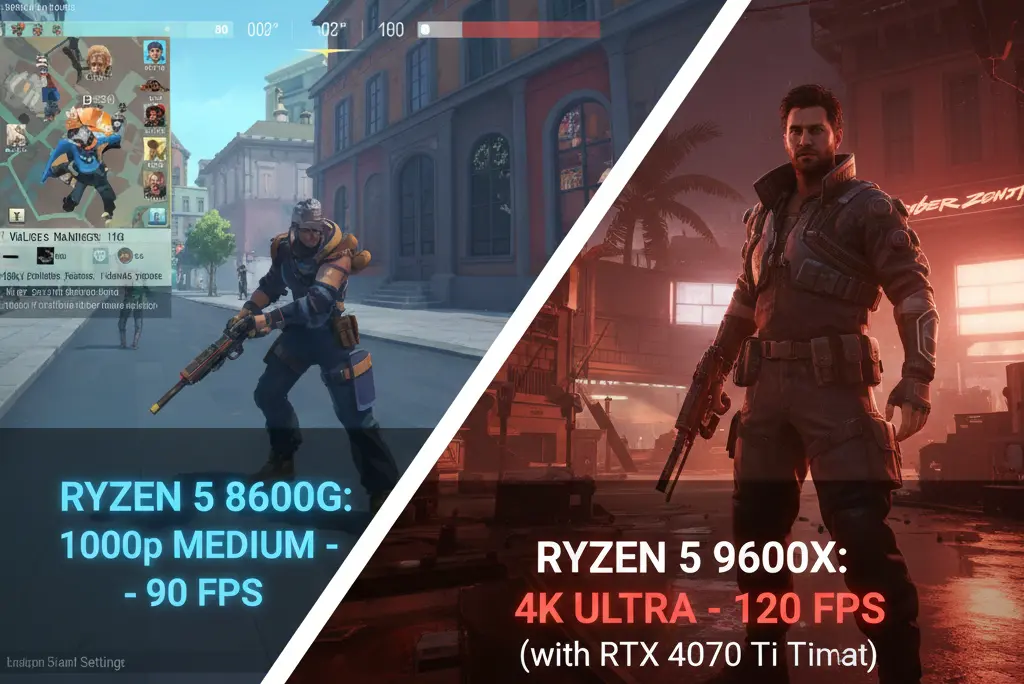
When comparing Ryzen 5 8600G vs Ryzen 5 9600X, real-world usage matters more than raw specs.
- Esports & Casual Gaming:
The Ryzen 5 8600G handles esports titles smoothly at 1080p without a GPU, thanks to its RDNA 3 integrated graphics. - AAA Gaming with a GPU:
The Ryzen 5 9600X delivers higher FPS and better 1% lows when paired with a discrete graphics card. - Content Creation & Productivity:
Video editing, 3D rendering, and code compilation favor the 9600X due to higher sustained clocks. - Everyday Tasks:
Web browsing, office work, and media consumption feel equally fast on both CPUs.
Summary: The 8600G is about convenience and efficiency, while the 9600X is about performance headroom.
Power Consumption & Cooling Considerations
Thermals and power draw can affect noise, cooling cost, and PSU requirements.
- Ryzen 5 8600G (65W TDP):
- Runs cooler and quieter
- Stock cooler is sufficient
- Excellent for compact or silent builds
- Ryzen 5 9600X (105W TDP):
- Higher power draw under load
- Benefits from a quality air cooler or AIO
- Requires a stronger PSU when paired with a GPU
If efficiency and low heat matter, the 8600G has a clear advantage.
Upgrade Path: Which CPU Makes More Sense Long-Term?
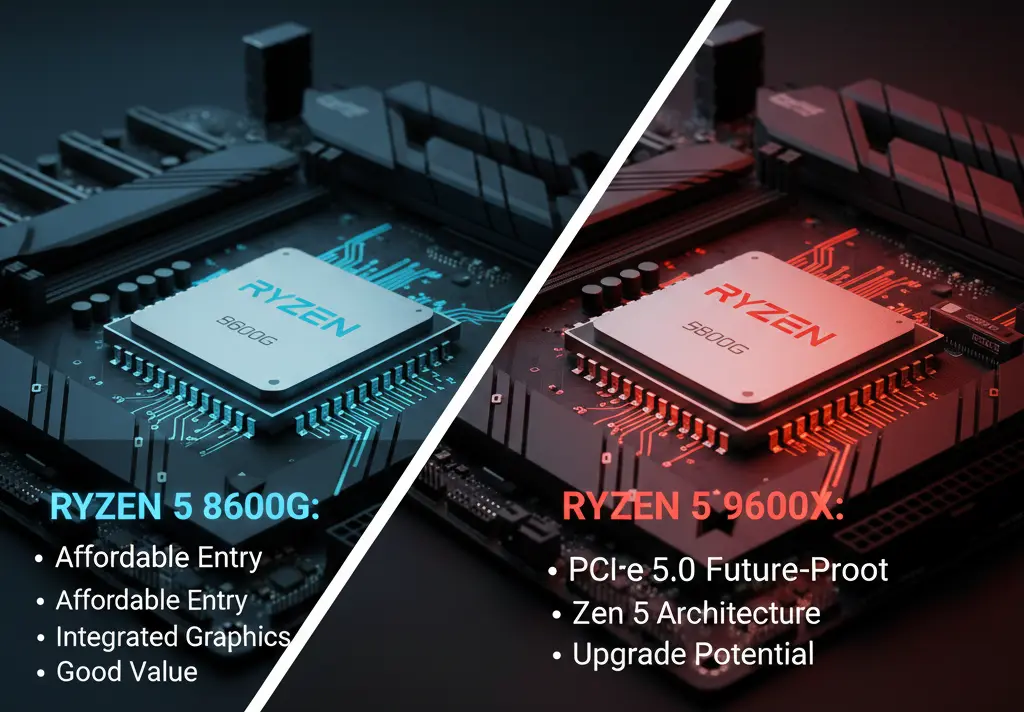
Both CPUs use the AM5 platform, ensuring future upgrade potential—but in different ways.
- Ryzen 5 8600G:
Ideal if you’re starting without a GPU. You can add a graphics card later without replacing the CPU. - Ryzen 5 9600X:
Better suited for future high-end GPUs and demanding workloads.
If you plan gradual upgrades, your choice should match that path.
Key Takeaways
Here’s what matters most in the Ryzen 5 8600G vs Ryzen 5 9600X debate:
- Generational Leap: The Ryzen 5 9600X utilizes Zen 5, providing roughly a 20% performance uplift in CPU-heavy tasks over the 8600G’s Zen 4 cores.
- The GPU Factor: The 8600G’s Radeon 760M is capable of “real” gaming at 1080p, while the 9600X’s iGPU is essentially just for office work and troubleshooting.
- Cache is King: With double the L3 cache (32MB vs 16MB), the 9600X significantly reduces latency in high-framerate gaming.
- Platform Longevity: Both use the AM5 socket, but the 9600X supports PCIe 5.0, making it more future-proof for next-gen SSDs and GPUs.
Pros & Cons – Ryzen 5 8600G and Ryzen 5 9600X
Every build has a budget, and understanding the trade-offs of the ryzen 5 8600g or ryzen 5 9600x is essential for making the right purchase.
A balanced look at strengths and weaknesses.
Ryzen 5 8600G
Pros
- Strong integrated graphics
- Low 65W power draw
- No GPU required
- Ideal for budget and SFF builds
Cons
- Lower CPU performance
- Limited for high-end gaming
- Not ideal for heavy rendering
Ryzen 5 9600X
Pros
- Higher boost clocks
- Excellent gaming with a GPU
- Strong productivity performance
Cons
- Requires a discrete GPU
- Higher power consumption
- Higher total system cost
Buying Recommendations
Buy the Ryzen 5 8600G if: You are building a PC without a dedicated graphics card and want to play casual titles like League of Legends, Valorant, or CS2 at 1080p. It is the king of budget versatility.
Buy the Ryzen 5 9600X if: You already have (or plan to buy) a dedicated GPU like an RTX 4060 or better. The 9600X will ensure your processor never bottlenecks your graphics card.
Choose Ryzen 5 8600G if:
- You want a simple, GPU-free PC
- You build office, HTPC, or compact systems
- Efficiency and value are top priorities
Choose Ryzen 5 9600X if:
- You already own or plan to buy a GPU
- You play modern games at high frame rates
- You do CPU-intensive work like editing or compiling
Final Verdict
In the Ryzen 5 8600G vs Ryzen 5 9600X comparison, neither CPU is objectively better for everyone.
The 8600G is a highly versatile, efficient all-in-one solution, while the 9600X is a performance-focused processor built for gamers and creators using discrete GPUs.
Your build goals should decide the winner.
FAQ Section
Q1: No, does Ryzen 5 9600X have integrated graphics?
Ans: No, the Ryzen 5 9600X does not include integrated graphics and requires a discrete GPU.
Q2: No, is Ryzen 5 8600G good for gaming?
Ans: No, it’s suitable for esports and light gaming, but not high-end AAA gaming.
Q3: No, do both CPUs support DDR5 memory?
Ans: No, yes—both CPUs require DDR5 memory on the AM5 platform.
Q4: No, which CPU is better for office work?
Ans: No, the Ryzen 5 8600G is better due to lower power usage and built-in graphics.
Q5: No, does Ryzen 5 9600X outperform 8600G in productivity?
Ans: No, yes—the 9600X performs better in rendering and heavy multitasking.
Q6: No, can Ryzen 5 8600G run without a GPU?
Ans: No, yes—it is designed to run without a discrete graphics card.
Q7: No, which CPU is more future-proof?
Ans: No, both are future-proof on AM5, but the 9600X scales better with powerful GPUs.
Short Conclusion
In the battle of Ryzen 5 8600G vs. Ryzen 5 9600X, your choice depends entirely on your GPU plans. If you’re going “naked” without a card, the 8600G is your champion. If you’re building a proper gaming rig, the 9600X is the clear winner.
If you want efficiency, simplicity, and value, choose Ryzen 5 8600G.
If you want maximum performance and plan to use a GPU, Ryzen 5 9600X is the better investment.
If you have any questions about this post, “Ryzen 5 8600G vs Ryzen 5 9600X: Integrated Graphics vs Pure Zen 5 Power,” please let us know by your valuable comment.


